Managed Services Telecom Guide for Indiana SMBs
A third-party provider takes day-to-day ownership of a business's voice, internet, and network infrastructure under SLAs, so the customer stops babysitting carriers and bills. In the telecom managed services market, that model sits inside a sector estimated at USD 20.67 billion in 2022 and projected to reach USD 55.29 billion by 2030 with a 13.4% CAGR (Grand View Research).
For a 35-person Greenwood office, that usually means the difference between one accountable partner and a pile of carrier tickets nobody wants to own. If you've got aging gear, spotty Wi-Fi in an old brick building, or three vendors blaming each other for a dead phone, this is the cleaner way to run telecom.
What Managed Services Telecom Means
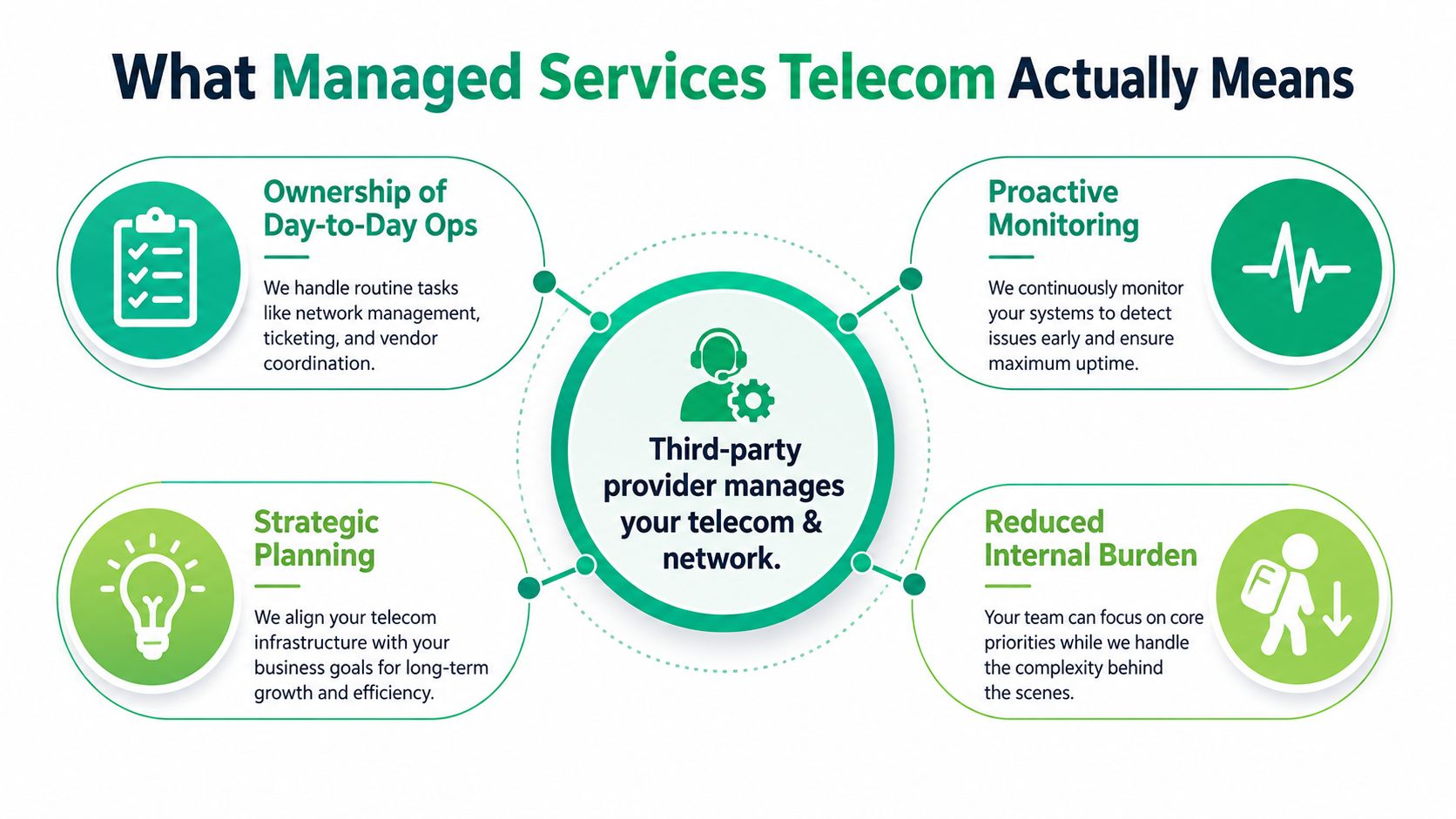
Managed services telecom means a third-party provider takes day-to-day ownership of voice, internet, Wi-Fi, SD-WAN, monitoring, and carrier coordination under written service level agreements. The business stops acting as the go-between for carriers, invoices, and support queues, which is where a lot of wasted time hides.
That is a different model from break-fix support. Break-fix waits until the phone system fails, then sends help after the outage already hit the office. Carrier-managed service usually covers the box the carrier owns at the curb or demarc, not the rest of your environment. A plain MSP contract can be a good fit for endpoints and servers, but if it does not touch the WAN, you still own the part that causes most of the headaches.
A Greenwood accounting firm with three carriers, two ISPs, and a printer nobody can reach does not need another dashboard. It needs one team that owns the moving pieces, catches trouble before the office manager sees it, and handles the escalation with the carrier that keeps pointing at the other carrier. That is the operational value, one accountable partner, one set of SLAs, one place to call when the phones start acting up.
Practical rule: if a vendor will not say who owns the circuit, who owns the router, and who owns after-hours escalation, you are still doing the coordination work yourself.
The clearest way to understand the model in a real access-control setup is how cellular gate openers work. The gate is not the point. The point is the managed layer that keeps the system usable without turning the office manager into a telecom technician.
If you want the broader IT version of the same outsourcing model, the local breakdown on managed IT services for Indiana businesses pairs well with this telecom-focused view.
Core Services a Telecom Managed Provider Handles
The service stack is bigger than phone lines and a help desk. A serious provider handles the communications layer, the network layer, and the administrative mess in between, so your staff doesn't spend Friday afternoon chasing firmware, invoices, and outage updates.
The communications side
UCaaS gives you voice, messaging, and collaboration in one platform, which is useful when remote work, desk phones, and mobile devices all need to behave the same way. SIP trunking replaces legacy PRI circuits by carrying call traffic over IP, which cuts the dependence on old voice hardware and makes capacity easier to scale. QoS policy keeps voice packets from fighting with backups and guest Wi-Fi, which matters when calls drop because someone is syncing a giant file.
That's the part most brochures describe badly. Under the hood, it's call control, bandwidth prioritization, and clean carrier handoff. If a provider can't explain how those pieces fit together, they're selling labels, not service.
The network and support side
SD-WAN is where the model starts paying rent. It steers traffic across multiple circuits based on policy, so a clinic or distribution office can keep working when one ISP stumbles. In a building with weak radio propagation or weird floor layouts, latency-optimized mesh nodes and cleaner access-point placement matter more than fancy marketing words.
A good provider also runs 24/7 NOC support, firmware patching, circuit monitoring, and SLA reporting. That means someone is watching for packet loss, jitter, or a dead edge device before a nurse, accountant, or plant manager starts calling. The more mature setups use bit-level packet inspection and SOC-as-a-Service style monitoring to separate real faults from random noise.
For a deeper telecom-voice comparison, the local guide at PBX and VoIP for Indiana businesses is a useful companion piece.
A managed provider should be able to tell you whether the next fix is a config change, a carrier ticket, or a truck roll. If every issue becomes a truck roll, you're paying for motion, not management.
How Managed Telecom Prevents Downtime and Pays for Itself
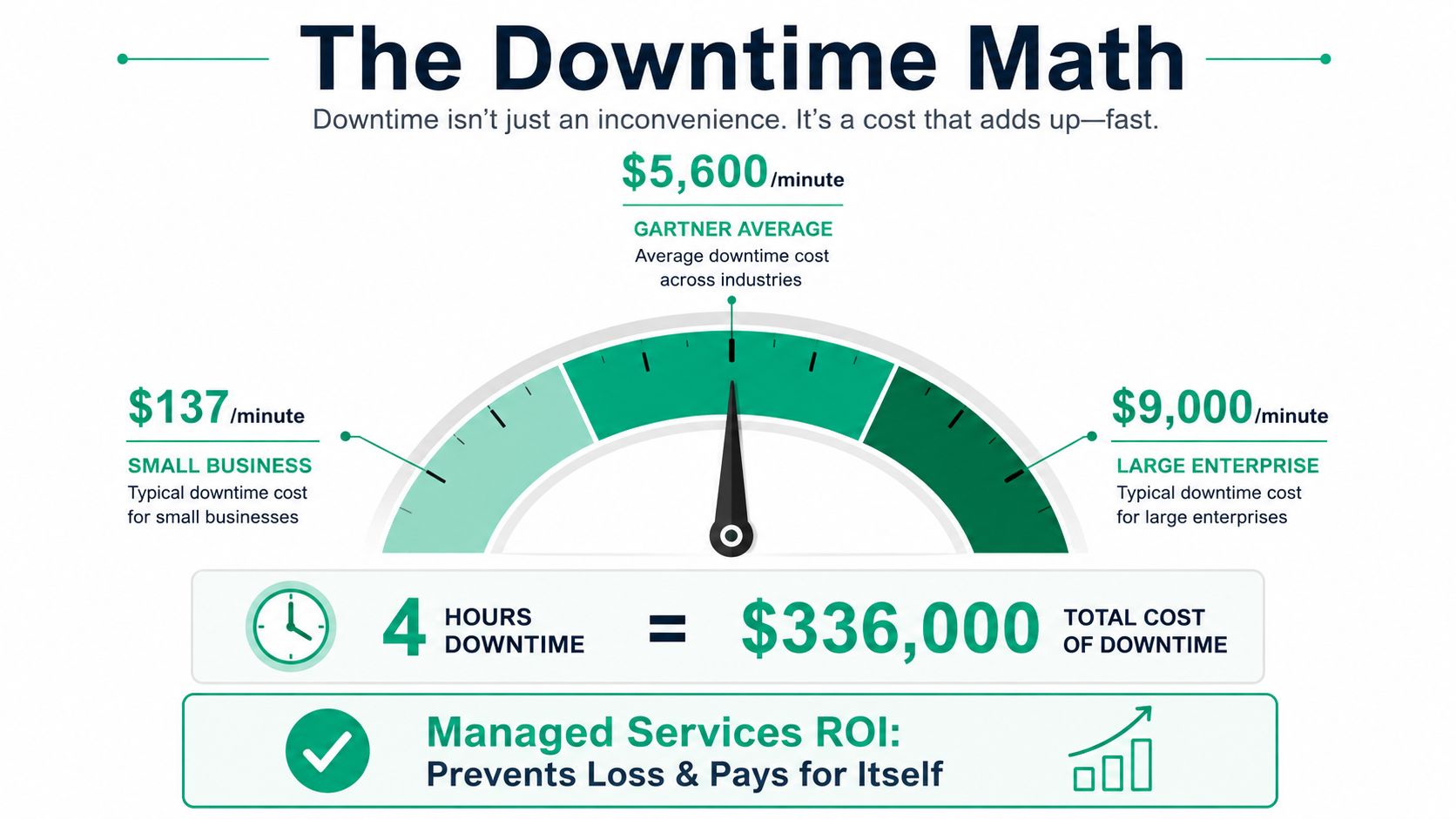
Downtime is where the budget argument gets real. Atlassian cites Gartner's estimate of $5,600 per minute on average, while a 2016 Ponemon Institute report puts the figure at nearly $9,000 per minute for larger operations; the same source notes small businesses may still lose $137 to $427 per minute (Atlassian). That turns a short outage into a boardroom problem fast.
A managed model changes the math because it pushes work from reactive to preventive. If a line goes flaky on a Tuesday morning and the provider catches the issue before lunch, that's not just less pain. It's fewer lost calls, fewer idle staff minutes, and fewer client meetings pushed to tomorrow.
The other savings show up in the junk no one budgets for. Multi-carrier bills, contract sprawl, and “who owns this circuit?” meetings waste office-manager time every week. A managed telecom provider consolidates the stack into one predictable monthly line item, which is easier to defend than a pile of surprise charges plus emergency fixes.
For a Johnson County professional services firm, that matters because tech time should be billable time. Every hour spent waiting on a carrier callback, swapping cables, or nursing a failing phone system is an hour not spent on client work. Predictable service also makes cash flow cleaner, which is the kind of thing a CFO notices even if nobody puts it in a sales deck.
The business-continuity angle is the one that usually lands. A solid telecom partner helps keep the phones up, the circuits clean, and the office off the emergency repair treadmill, which is the same logic behind broader continuity planning for Indiana SMBs at business continuity planning services for Indiana SMBs.
Common Pricing Models and What They Really Cost
Most Indiana SMBs run into three pricing structures. The right one depends on seat count, site count, and whether you want clean billing or operational simplicity. The wrong one usually looks cheap right up until the overages hit.
| Managed Telecom Pricing Models Compared | Best Fit | Typical Indiana Range | Watch For |
|---|---|---|---|
| Per-seat | UCaaS-heavy offices with stable headcount | Varies by bundle and support scope | Overages, add-on features, and handset rental terms |
| Per-site | Multi-location businesses with consistent site needs | Varies by circuit mix and device count | Site minimums, dispatch charges, and hardware exclusions |
| All-inclusive managed capacity | Operators that want one accountable vendor across locations | Varies by capacity and service level | End-of-term buyouts, unused capacity, and contract lock-in |
Per-seat pricing is common when voice, messaging, and support are bundled together. It works when staff count is the primary driver. The trap is that add-ons can stack quickly, especially if after-hours support or higher-tier call routing gets billed separately.
Per-site pricing often shows up in SD-WAN and monitoring. It's easier to forecast for a branch network, but you need to know what each site includes. A cheap per-site quote can turn into a nuisance when the vendor treats every router swap, firmware push, or after-hours visit as extra.
All-inclusive managed capacity fits multi-location operators that want one relationship and less internal admin. It's the closest thing to utility-style billing, which is useful when leadership values predictability more than line-item micromanagement. The caution is hardware-as-rental and buyout language, because those terms can get expensive when the agreement ends.
TM Forum-aligned checks like TMF801 and TMF802 are starting to show up in proposals, and that matters because service-fulfillment validation isn't just a buzzword when two bids look alike on paper. If a provider can't show how fulfillment gets verified, you're comparing promises instead of operational proof.
For a deeper local cost comparison, what managed IT services cost in Indiana helps frame the broader spend picture.
Security and Compliance Across Indiana Verticals
Telecom touches security faster than most owners expect. Voice, messaging, remote access, and network management all create paths a bad actor can use if the environment is sloppy. That means the compliance conversation has to start with the business type, not the vendor brochure.
Match the control set to the industry
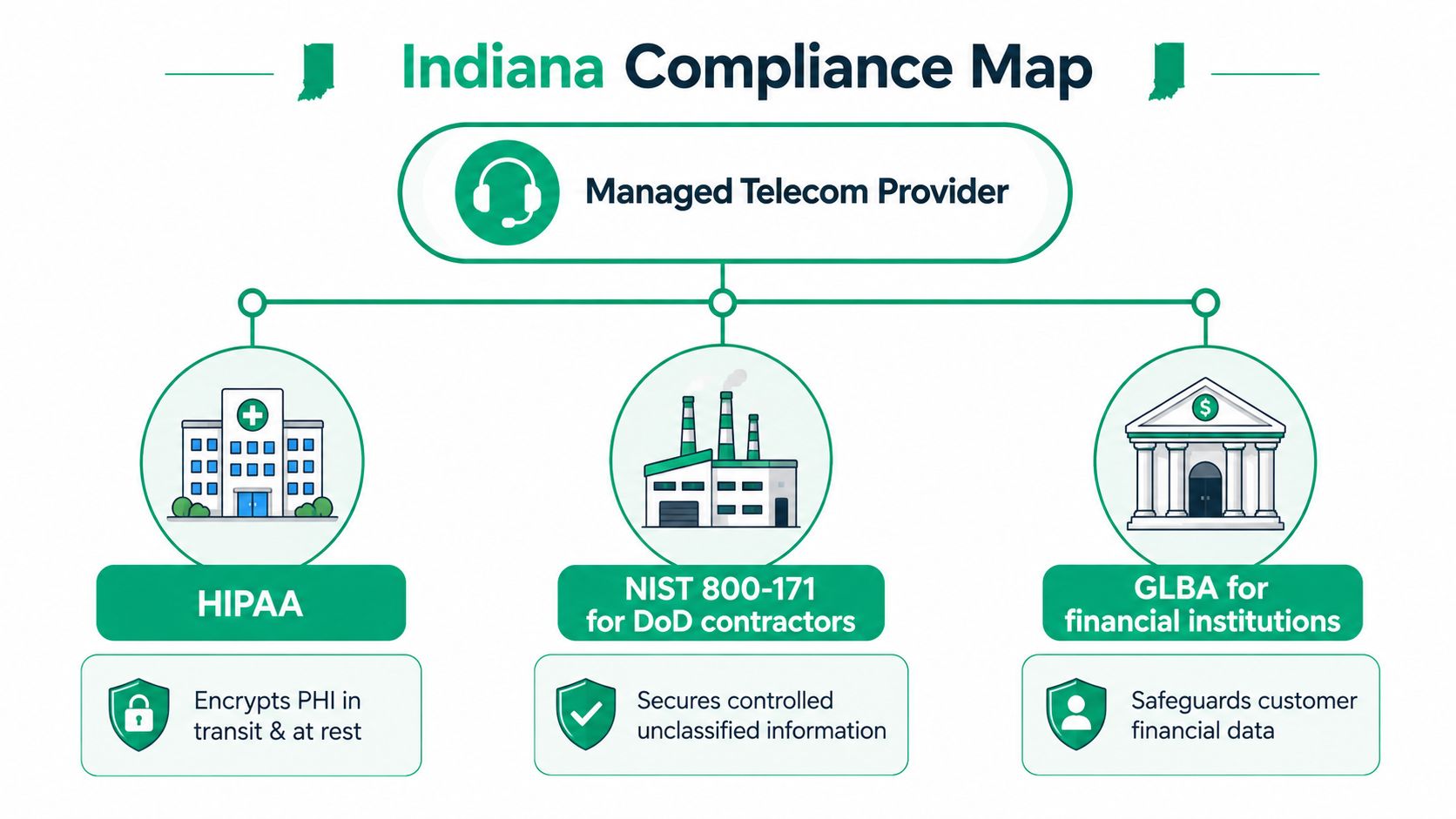
A healthcare practice along the I-65 corridor needs HIPAA discipline, which means voice traffic, messaging, and stored data have to be handled with care. A defense subcontractor in the Indy metro needs to think in terms of CMMC and controlled data handling. Retail and e-commerce operations need PCI-DSS habits around payment data, while NIST CSF remains a common baseline for general business security.
Managed telecom supports those needs when it uses encrypted SIP with TLS, immutable off-site backups, and endpoint protection tied into Zero Trust architecture. A compromised phone system should not be able to pivot into the billing server, and a failed switch should not expose stored telemetry just because the network got messy. Tools like Bitdefender GravityZone or similar endpoint controls fit into that broader managed stack.
What the provider must do
The technical details matter. Centralized and distributed architectures with N+1 redundancy at both primary and disaster-recovery sites help preserve service when a node fails. Encrypted data storage and transfer protect telemetry in transit and at rest. Continuous vulnerability-signature updates keep the security layer from going stale.
If a vendor says “we're secure” but can't describe encryption, redundancy, and backup recovery in plain English, keep walking.
The compliance map for Indiana should not feel abstract. It should tell you whether the provider can support a medical office, a factory, or a financial team without forcing your staff to become security researchers. That is also why a formal review like compliance and security for Indiana SMBs belongs in the buying process.
Central Indiana Case Examples and What Changed
A Greenwood manufacturer called after the same thing kept happening on the plant floor, dropped calls during shift handoffs and a PBX that looked tired every time someone opened the cabinet. In our 17 years of local service, that pattern usually means the problem isn't one thing, it's the stack. The fix was SD-WAN over dual circuits, SIP trunking, and cleaner traffic rules so voice stopped getting bullied by everything else.
The change was simple to describe and hard to argue with. Shift supervisors could finish handoffs without repeating themselves, and the plant stopped treating every phone hiccup like an emergency. The old on-prem PBX had become a bottleneck, not an asset.
The clinic that needed room to grow
A Hamilton County clinic scaling from two providers to five needed HIPAA-compliant voice, encrypted messaging, and a failover path before its next survey window. The issue wasn't just call quality. It was whether front-desk staff, providers, and remote coordination would still work if a circuit blinked or a device failed.
That's where managed telecom earns its keep. The provider had to think through secure voice, backup paths, and continuity, not just phone extensions. When we disassembled a similar client's failing RAID array, the lesson was the same, recovery gets expensive when nobody planned for the failure path.
The clinic's outcome wasn't flashy. It was better. Staff stopped improvising around outages, and the team could focus on patient flow instead of hunting down a repair window. That's the quiet win most owners want.
The reason these stories matter is that the same model works for different shapes of business. A plant, a clinic, and a professional office all need uptime, but they need it for different reasons and with different controls. Managed telecom handles that when the provider understands the environment instead of forcing a one-size-fits-all bundle.
Choosing the Right Provider Without Getting Burned
Start with credentials, but don't stop there. Microsoft, CompTIA, and Cisco certifications tell you the team has baseline technical training, but they don't prove they can support your exact environment. The better test is whether they can explain your voice stack, your circuits, and your recovery path without talking in circles.
The filter that saves time
- Check the response promise: Ask for local onsite timing in writing, especially for Greenwood and nearby Johnson County offices.
- Read the SLA, not the brochure: Response targets and resolution targets should be spelled out, not implied.
- Ask who owns what: Separate managed services from co-managed tasks so nobody hides behind vague boundaries.
- Call real references: Speak with at least two Indiana businesses that match your size or industry.
- Review after-hours terms: Make sure dispatch rules, escalation paths, and support windows are clear before signing.
If a provider won't put the onsite promise into the agreement, they're asking you to trust marketing instead of operations. The same goes for vague “24/7 support” language that sends SMBs into an offshore queue first. Long lock-ins and hidden buyout language are another red flag, especially when hardware is treated like a lease but priced like ownership.
A provider that's right for a Greenwood office usually isn't the one with the slickest deck. It's the one that can explain failure handling, carrier escalation, and support boundaries in plain language. You want a firm that knows the I-65 corridor as a service area, not just a map pin.
If you're already reviewing proposals, bring this checklist to the meeting and force each vendor to answer the same questions. The good ones won't mind.
Your Next Step Toward Predictable Telecom
Managed telecom gives Greenwood and Indianapolis businesses one accountable partner, one predictable monthly bill, and the uptime posture a Fortune 500 expects without the Fortune 500 overhead. For offices in Greenwood, Johnson County, Hamilton County, downtown Indy tech hubs, and the I-65 corridor, a Free Network Assessment or Security Risk Audit is the cleanest way to see where the current stack is wasting time and where it's one outage away from a bad month.
Finchum Fixes IT helps Indiana businesses tighten telecom, networking, cybersecurity, and support so the office runs without constant carrier drama. If you want a practical review of your voice, internet, and network setup, visit Finchum Fixes IT and ask for a Free Network Assessment.