Network Installation Cost for Indiana SMBs

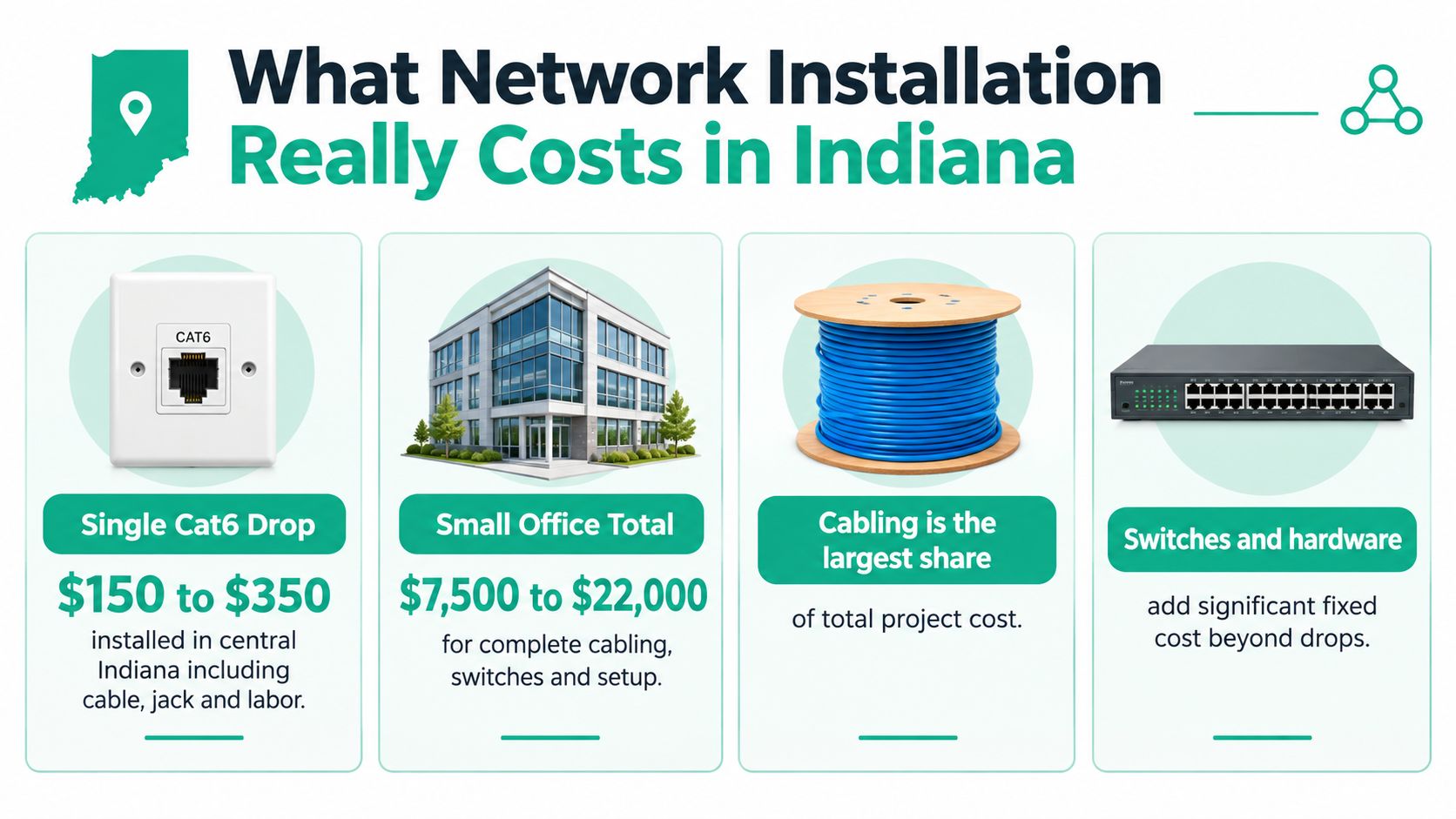
A typical commercial Cat6 drop runs about $150 to $350 installed, a small office total usually lands between $7,500 and $22,000, and labor plus access conditions, not cable, drive the final number.
That's the number Greenwood business owners need before calling a contractor. The office may have aging switches in a Greenwood business park, dead zones inside an old brick building, or a move planned along the I-65 corridor. A low bid can look attractive until crews discover hard ceilings, occupied offices, return-air spaces, or a telecom room that was never documented.
The right question isn't “What does network installation cost?” It's, “What will this installation prevent, and what conditions will change the price?” A properly scoped project protects billable work, supports cybersecurity, and gives your team a network it can maintain instead of another mystery behind a locked closet door.
What Network Installation Really Costs in Indiana
Central Indiana businesses usually buy network installation by the drop, not as one flat project fee. A standard commercial copper drop commonly runs $100 to $350 installed, with Cat6 often around $175 to $275 and Cat6A around $200 to $400 per drop, according to industry structured cabling pricing data. Recent local pricing guidance places straightforward commercial Cat6 work around $150 to $250 per drop, with harder Cat6A, plenum, and certification-heavy installations reaching $200 to $350 or more per drop, as outlined by Data Wire Solutions.
Small offices commonly fall between $7,500 and $22,000 once cabling, switches, firewall configuration, wireless access points, and labor are bundled. That range fits a modest Greenwood professional-services suite far better than a national average because it accounts for the equipment around the drops.
A network project also functions as downtime insurance. A benchmark compiled by OutageCost lists average downtime at $8,851 per minute, while another cited benchmark uses $5,600 per minute. A connectivity failure during tax preparation, payroll, medical scheduling, or quarter-close can consume the entire apparent savings from postponing the work.
Three Indiana project types
- New construction: A Greenwood office-park tenant buildout is usually the cleanest job. Open ceilings and accessible pathways let crews prewire before walls close. One benchmark places new-construction structured cabling around $3 to $5 per square foot, while another commercial-building estimate uses roughly $0.65 to $1.25 per square foot, showing why scope definitions matter. The Unio Digital benchmark explains how site complexity changes the calculation.
- Retrofit: Older Indianapolis buildings along Meridian Street often require wall fishing, lift access, ceiling removal, and patching. Fiber work in difficult retrofits can reach $800 to $1,000 or more per drop, according to the same structured cabling cost benchmark.
- Compliance-driven installation: A Hamilton County medical or financial branch may need documented testing, segmented networks, protected equipment rooms, and controlled access. HIPAA, PCI-DSS, or internal audit requirements can matter more than the cable category.
For a practical planning reference, compare your scope with this Indiana network infrastructure upgrade guide. Labor and access conditions decide the invoice. Cable is only one line item.
The Six Cost Buckets Behind Every Quote
A vendor quote should separate the physical plant from the equipment and the work required to install it. If every charge appears under one vague “network installation” line, you can't compare bids or identify the change order waiting to happen.
The six buckets below are the useful starting point:
| Bucket | Share of Total | Typical Range |
|---|---|---|
| Cable and jacks | 15% to 25% | $150 to $350 per drop |
| Hardware | 25% to 40% | Scales with ports, firewall, and PoE |
| Labor | 35% to 50% | $85 to $150 per hour in Indianapolis |
| Design and documentation | Smaller share, project-dependent | $2,000 to $4,500 for a 200-drop site |
| Licensing | Recurring | Microsoft, firewall, and Wi-Fi management subscriptions |
| Wireless access points | Equipment plus installation | $400 to $900 per commercial AP |
These figures come from the provided Indiana installation planning brief, while the per-drop ranges align with commercial structured cabling pricing summaries. Treat them as planning bands, not a promise from a contractor.
What usually moves the total
Labor is the silent majority. Technicians spend time tracing pathways, fishing cable, lifting ceiling tiles, terminating jacks, labeling patch panels, testing each run, and documenting the result. A short cable path through an accessible drop ceiling can be inexpensive. The same path through a finished wall or return-air plenum can become a labor problem.
Hardware creates fixed cost. A switch still costs money even when your cable count is modest. Port capacity, Power over Ethernet for phones and cameras, firewall throughput, rack hardware, UPS protection, and redundant links all change the design.
Design prevents future waste. A basic office may need only a clean floor plan and patch-panel schedule. A dense site needs CAD drawings, cable IDs, rack elevations, VLAN planning, and test documentation. That engineering work looks optional until a technician has to troubleshoot an unlabeled run during an outage.
Wireless adds another decision. Commercial access points need suitable mounting locations, Ethernet backhaul, PoE, channel planning, and management licensing. A cheap AP installed in the wrong place is not a savings. It's a future service call.
For a plain-English look at the physical side, use this business owner's Cat6 installation guide. Ask every bidder to identify which of these six buckets is included, excluded, or estimated.
Wired Versus Wireless and When Each Wins
Wired and wireless networks solve different problems. The mistake is treating them as competing religions instead of comparing the cost per user, the building conditions, and the length of time the layout will stay stable.
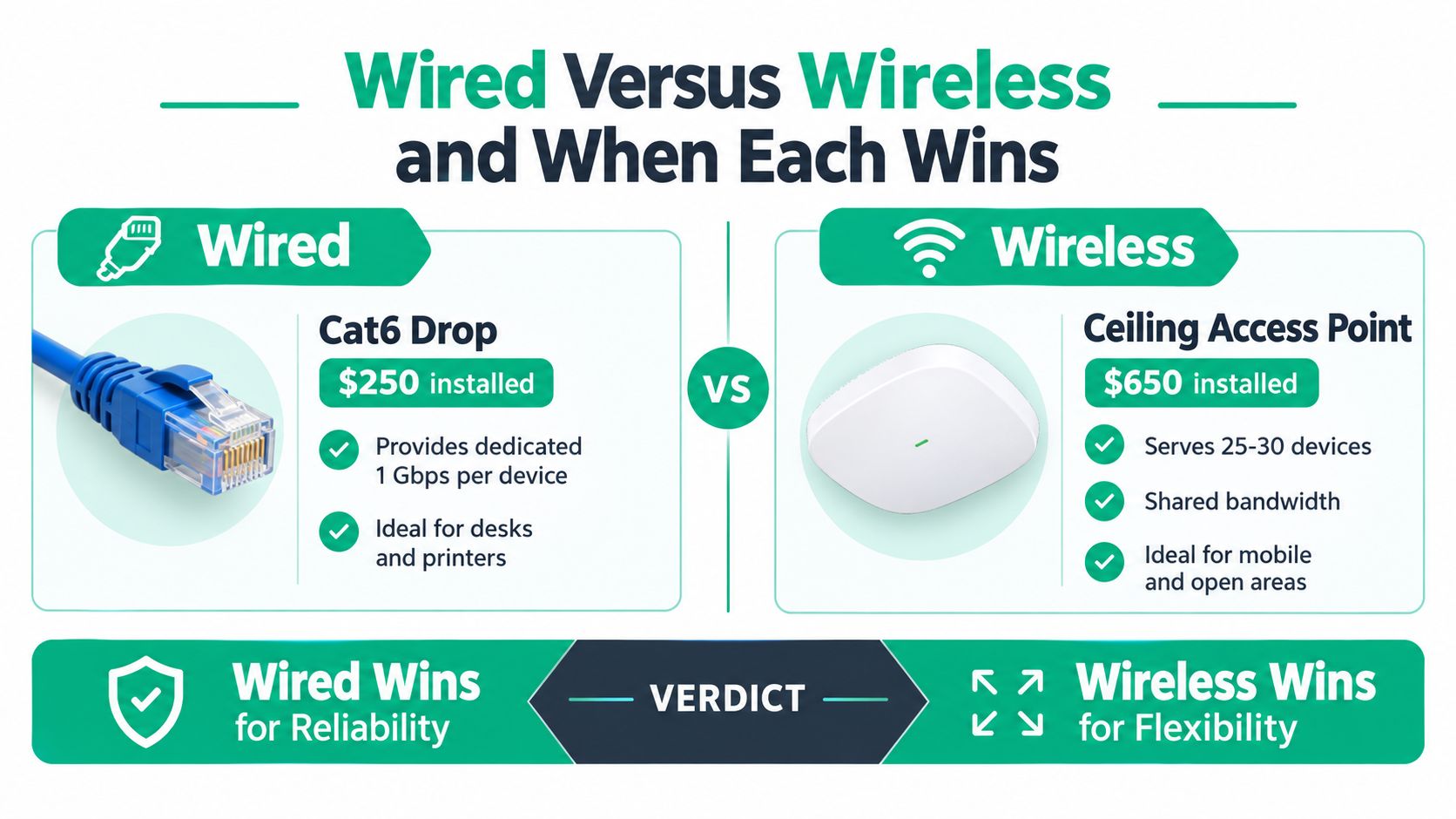
A Cat6 drop at $250 installed can beat a $650 ceiling-mounted access point serving the same desks once the AP's shared capacity is divided among users. Those planning figures appear in the supplied Indiana comparison brief. Fixed desks, printers, phones, cameras, point-of-sale terminals, and production equipment should generally get a cable.
Wireless wins when mobility or physical access dominates. An I-65 warehouse may change rack positions regularly. An older Indianapolis retail building may make cable pathways difficult, particularly when renovation constraints affect ceilings and walls. A temporary branch office can also favor wireless because the layout may change before a permanent cabling project makes sense.
The practical hybrid design
Most Indiana SMBs should choose a hybrid:
- Cat6 backbone: Connect telecom rooms, fixed workstations, printers, cameras, and phones.
- Wi-Fi 6E: Serve guests, mobile staff, conference rooms, and shared spaces.
- Latency-optimized mesh nodes: Use them only where cabling between buildings or hard-to-reach areas creates a worse construction problem.
- Point-to-point bridges: Connect separate buildings on a Greenwood campus when trenching or new conduit isn't sensible.
- VLAN segmentation: Keep guest, employee, voice, camera, and operational traffic separated through managed switches and firewall policy.
A wireless site survey should measure signal strength, noise floor, channel utilization, and interference while walking the facility. The technician imports a floor plan, records current AP locations, surveys the space with software, and uses the results to adjust AP placement, cabling, channel plans, or power settings. This enterprise Wi-Fi troubleshooting workflow describes that diagnostic approach.
Practical rule: If more than 70 percent of devices will stay at one desk for three years, cable first.
Use this Indiana SMB Wi-Fi installation cost guide when the project includes wireless coverage rather than Ethernet alone.
Realistic Budgets for Three Indiana Site Types
A useful budget starts with the building, not the spreadsheet. The same number of drops can cost very differently in an open Greenwood buildout, a finished Hamilton County branch, and a high-bay warehouse beside I-65.
The following planning scenarios use the supplied site assumptions. They're editorial planning examples, not customer case studies or guaranteed bids.
| Line Item | Greenwood Office (4,500 sq ft) | Hamilton County Branch (9,000 sq ft) | I-65 Warehouse (40,000 sq ft) |
|---|---|---|---|
| Core scope | 18 Cat6 drops, switches, firewall, APs | Fiber between floors, plenum cable, APs | Cat6A, bridges, conduit, high-bay APs |
| Site conditions | Drop ceiling, occupied office | After-hours work and vertical pathways | High ceilings and outdoor connections |
| Estimated total | $11,500 to $16,800 | $28,000 to $41,000 | $52,000 to $78,000 |
| Biggest swing item | Switch and firewall selection | Fiber pathway and after-hours labor | Conduit, lift access, and bridge mounting |
Greenwood professional office
An office suite with 18 Cat6 drops, one stack of UniFi or Meraki switches, a cloud-managed firewall, and dual-band APs can stay within the Greenwood range when the ceiling and telecom room are accessible. The cost moves upward when the business insists on work outside operating hours or discovers that the existing rack has no usable power protection.
The fixed-desk count drives the cable scope. The switch stack and firewall create the equipment floor. A clean patch-panel map matters because future support becomes faster when every jack has a documented destination.
Hamilton County branch
A financial-services branch with fiber between floors needs more than horizontal cable. Plenum-rated cable, vertical pathways, after-hours work, testing, and controlled access can push the project into the $28,000 to $41,000 range. The single largest swing is usually access to the riser and the hours available for installation.
That branch also needs security planning. A Zero Trust architecture, segmented VLANs, MFA-backed administrative access, and documented firewall rules help the network support audit expectations instead of merely passing traffic.
I-65 warehouse
A 40,000-square-foot logistics site needs Cat6A, conduit, outdoor-rated wireless bridges, and high-bay AP mounting. Lift access, cable protection, warehouse interference, and the physical distance between distribution areas explain the $52,000 to $78,000 planning range.
For a broader contractor-selection checklist, review this 2026 Indiana structured cabling contractor guide. Don't accept a warehouse quote that hides mounting, conduit, lift rental, or bridge configuration inside “miscellaneous.”
How to Estimate Your Own Install in One Afternoon
You can produce a useful internal estimate before issuing an RFP. It won't replace a site walk, but it will stop vendors from quoting different projects under the same title.
Start with the floor plan
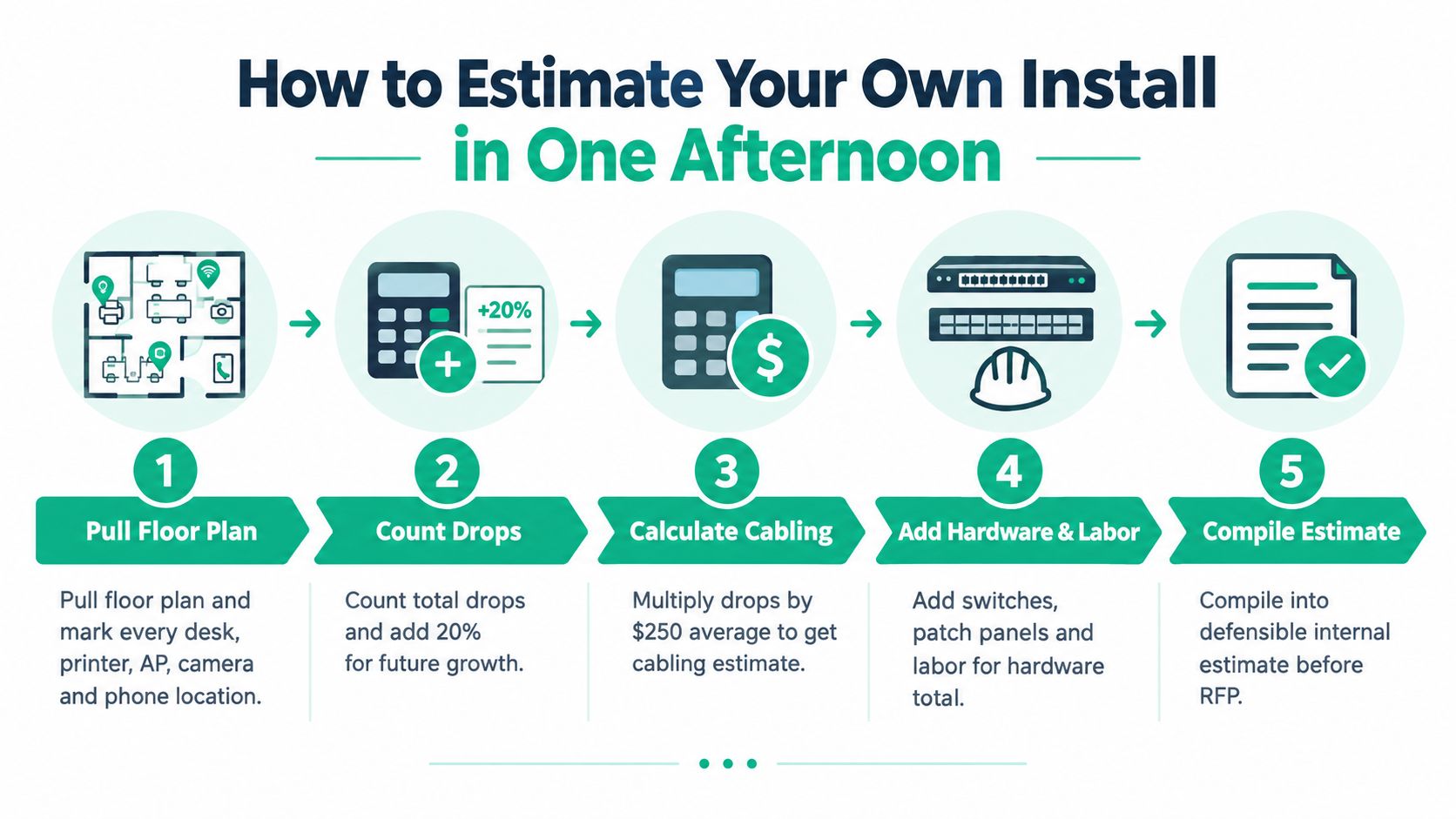
Pull the current plan, not the version from the original lease. Mark every desk, printer, phone, camera, AP, conference-room display, badge reader, and fixed device. Each symbol represents a drop or wireless node that someone must power, connect, test, and support.
Then count by floor and by device type. Keep workstations separate from APs and cameras because they may require different switch ports, PoE budgets, or mounting methods.
Classify access before multiplying drops
Record whether each route crosses a drop ceiling, hard lid, exposed structure, plenum space, warehouse rack area, or finished wall. Mark risers, locked rooms, exterior walls, and areas where ladders or lifts may be required.
A practical estimate can use the supplied $250 average per drop as a starting point for cabling, then add switches, patch panels, firewall hardware, APs, testing, and labor. Don't treat that average as a final price. It only gives you a baseline before site conditions change the scope.
Flag compliance and resilience requirements
Write down whether the business handles protected health information, payment data, government information, or regulated customer records. HIPAA, PCI-DSS, CJIS, and CMMC-related requirements can affect segmentation, documentation, access control, cable choices, backup power, and testing.
For general business governance, the NIST Cybersecurity Framework organizes work around identify, protect, detect, respond, and recover. That structure gives your vendor a better target than “make the Wi-Fi reliable.”
Scope the equipment
Specify switch port count, PoE demand, firewall throughput, UPS capacity, management subscriptions, and redundancy. Note whether you want UniFi networking, Meraki, or another platform. The brand matters less than whether the design includes lifecycle support, firmware management, monitoring, and replacement planning.
Finish with photos of the telecom room, rack, ceiling, riser, and service entrance. Send the same one-page scope to two or three Indiana vendors. This Indiana network design service guide can help you frame the questions.
Hidden Costs That Blow Up the Cheapest Bid
The cheapest bid often excludes the work that makes the installation difficult. Read the exclusions before comparing totals.
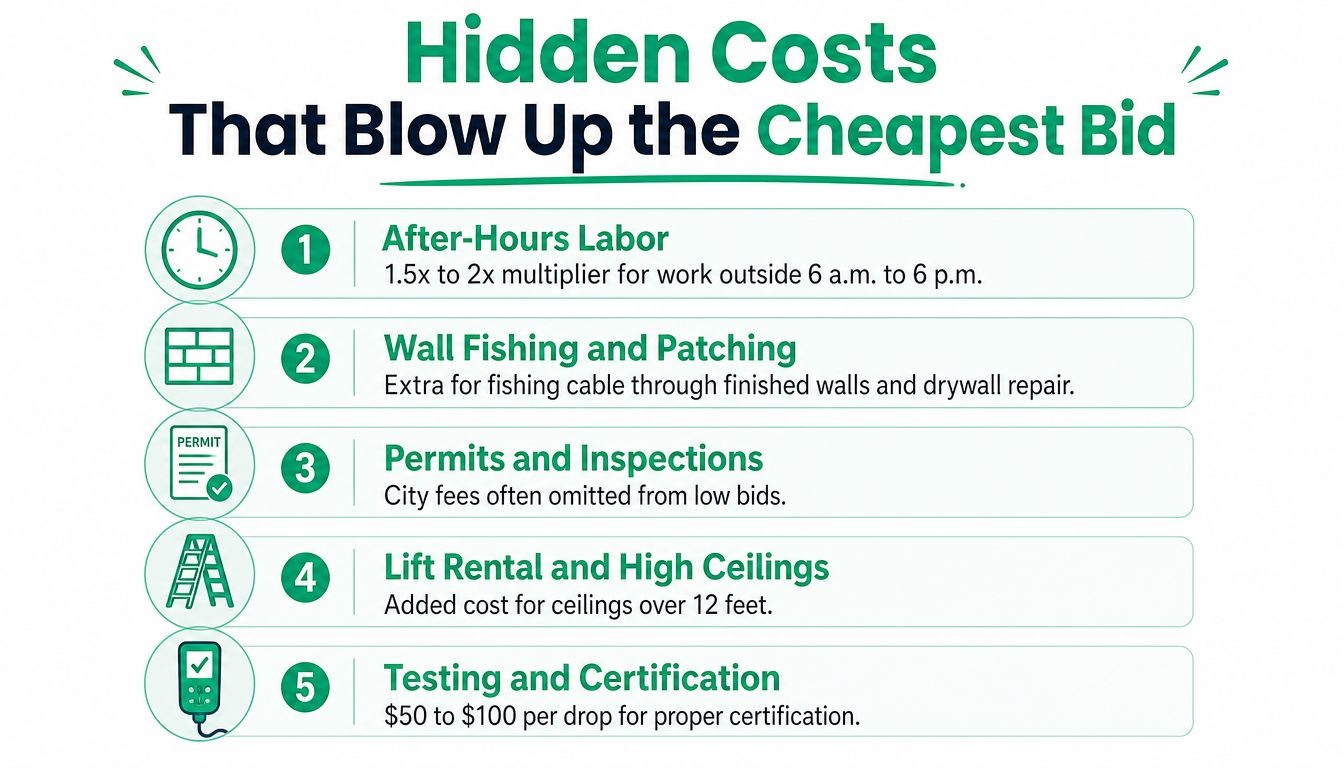
After-hours labor is the first trap. Work outside 6 a.m. to 6 p.m. may carry a 1.5x to 2x multiplier, and the supplied planning data places the impact around $1,200 to $3,400 for a mid-size install. If the front office must stay open, require the bidder to state the schedule and rate.
Plenum-rated cable costs more because return-air spaces require materials suited to that environment. The supplied estimate places plenum cable roughly 40% to 60% above standard Cat6 per foot. A quote that assumes standard cable without checking the ceiling may be wrong before work starts.
Certification testing separates a documented cable plant from a collection of lights that happen to turn on. Fluke or WireScope reports can run $8 to $14 per drop under the provided pricing guidance, and they matter for warranty support and future troubleshooting.
Force the exclusions into the open
- Wall and ceiling repair: Fishing finished walls can leave a patching bill. The supplied range for a punch list is $600 to $2,200.
- Survey and design: Site survey and design work may run $750 to $2,500, even when a vendor says the fee is waived. Some contractors recover it through hardware markup.
- Permits and inspections: City requirements can sit outside a low bid. Ask who files, pays, and schedules them.
- Lift rental: High ceilings and warehouse mounting require access equipment. Confirm whether the lift is included.
- Change-order language: Require written approval before any added labor, material, or repair work.
The provided network cabling cost guidance highlights why occupied offices, plenum spaces, certification, and finished-wall additions change the price. Put every one of those conditions into the RFP. It's cheaper than arguing about them after the ceiling is open.
Downtime, Compliance, and the ROI of Doing It Right
A network installation should earn its keep by preventing interruptions, reducing wasted technician time, and giving managers a predictable maintenance plan. The outage benchmark from OutageCost lists $8,851 per minute, while another cited figure is $5,600 per minute and more than $300,000 per hour. Those numbers vary by business, but the decision is simple: an outage can cost more than the cabling project.
The same logic applies to a small branch, a warehouse, or a mobile operation evaluating the best internet for RV businesses. Connectivity planning needs to account for failover, equipment health, traffic separation, and recovery procedures, not just the advertised internet speed.
Map the installation to controls
NIST CSF gives a general business a clear way to connect infrastructure work with security:
- Identify: Document racks, cable paths, switches, APs, circuits, devices, and dependencies.
- Protect: Use VLAN segmentation, Zero Trust architecture, protected administrative access, UPS-backed switches, and suitable firewall policies.
- Detect: Enable switch, firewall, AP, and endpoint alerts. SOC-as-a-Service monitoring can route suspicious activity and equipment failures to a response process.
- Respond: Maintain current diagrams, escalation contacts, configuration backups, and tested replacement procedures.
- Recover: Keep immutable off-site backups for configurations and business data, then document how the network returns to service.
CMMC can raise the stakes for defense contractors. One independent estimate places total CMMC costs at $30,000 to $150,000 for small contractors, $100,000 to $500,000 for mid-sized contractors, and $500,000 to $2,000,000 or more for large enterprises, with cost components including gap assessments, documentation, technology upgrades, certification fees, and annual staff training, according to Kiteworks' CMMC cost breakdown.
That's why installation belongs in a managed-IT lifecycle. The partner should own the design, labels, certification reports, configuration records, security alignment, and refresh plan. In our 17 years of local service, we've seen the expensive part arrive after the cable is installed, when nobody knows which port serves the failing device or which configuration was approved.
Get a Free Network Assessment for Your Business
Greenwood and Indianapolis business owners shouldn't approve a network installation from a verbal estimate. Request a Free Network Assessment and ask for five specific deliverables:
- A current-state topology map showing internet service, firewall, switches, APs, racks, and major dependencies.
- A drop count by floor for workstations, phones, printers, cameras, and wireless nodes.
- A wireless coverage heatmap based on an onsite survey of signal strength, noise, channel use, and interference.
- A written cost estimate with good, better, and best tiers, separating labor, materials, hardware, testing, licensing, and repair work.
- A prioritized punch list identifying fail-first items such as overloaded switches, undocumented cabling, weak coverage, unsupported firewalls, and missing backups.
Finchum Fixes IT offers that assessment for businesses in Greenwood, Indianapolis, Johnson County, and the surrounding Central Indiana market. A local crew can plan work around the front office, coordinate city permits, document the cable plant, and provide certification reports backed by a 25-year standard warranty expectation when the selected installation supports it.
Book a 30-minute walkthrough, send a recent floor plan, and request a written quote within five business days. The assessment costs nothing. Ignoring the network costs a known amount per minute when the business stops working.
Finchum Fixes IT provides Free Network Assessments, structured cabling planning, Wi-Fi surveys, cybersecurity alignment, and managed support for Greenwood and Indianapolis businesses. Visit Finchum Fixes IT to schedule your walkthrough and turn an uncertain network installation cost into a documented plan.